 SBA Loans
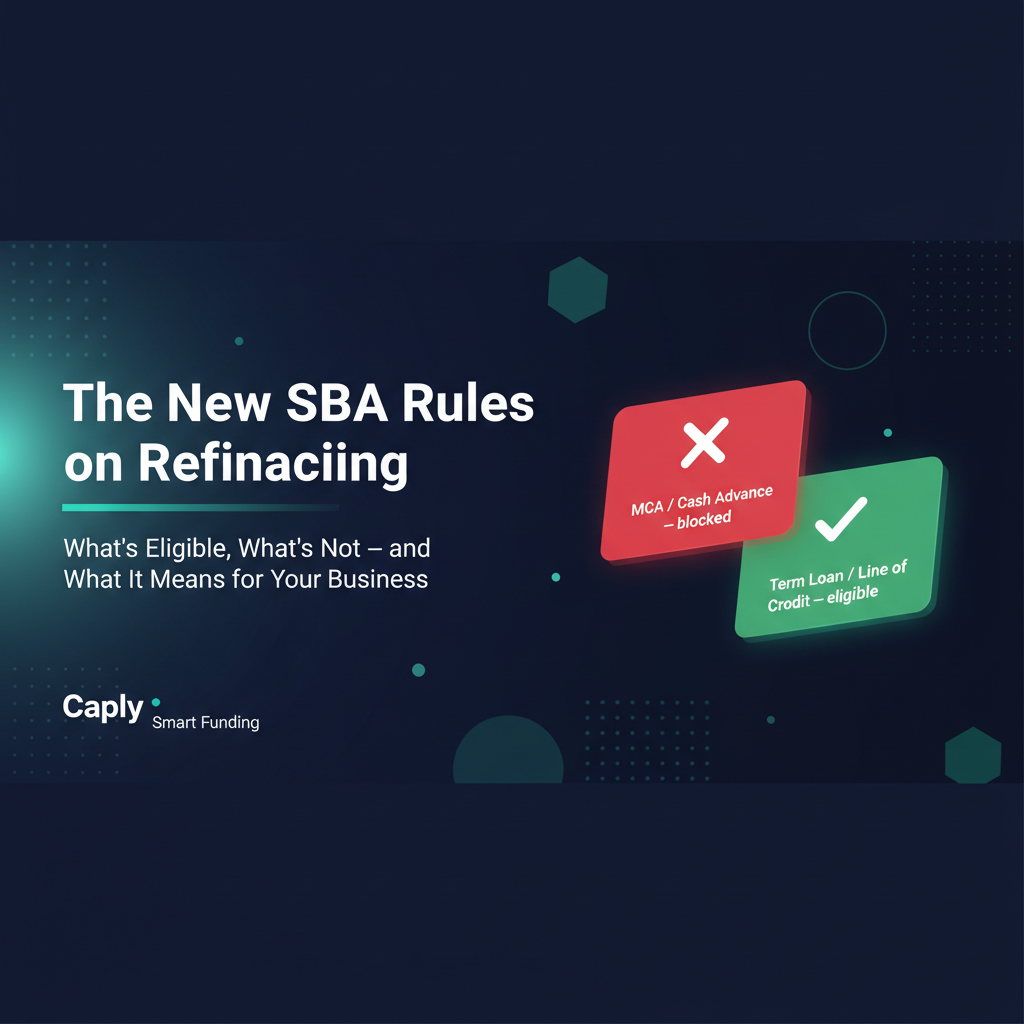
The New SBA Rules on Refinancing: What's Eligible, What's Not
The Exit Door Just Closed on MCA Refinancing — Here's What's Still on the Table
If you've been carrying high-cost short-term debt and quietly planning to refinance it into a lower-rate SBA loan someday — that window is either closed or closing fast, depending on what type of debt you have.
The SBA updated its Standard Operating Procedures (SOP 50 10 8) in April 2024, and those changes took full effect on June 1, 2025. The rules around what short-term debt is eligible for refinancing through an SBA 7(a) or 504 loan changed significantly. Here's what every small business owner needs to know.
What Changed — and Why
The SBA's changes weren't random. The agency was watching a pattern: business owners would refinance their merchant cash advance debt into a long-term SBA loan, then turn around and take out a new MCA almost immediately. The cycle repeated — and default rates on those SBA loans climbed as a result.
The SBA's response was blunt. Under the updated SOP, certain short-term financing products are now explicitly ineligible for refinancing through any SBA program — including 7(a), SBA Express, Export Express, International Trade loans, and 504 loans.
Effective June 1, 2025: "Merchant cash advances and factoring arrangements are not eligible for debt refinancing" under SBA SOP 50 10 8.
What You CANNOT Refinance with an SBA Loan
These products are now completely off the table:
- Merchant Cash Advances (MCAs) — The big one. MCAs are structured as a purchase of future receivables, not a traditional loan. The SBA now explicitly bars using 7(a) or 504 funds to pay off MCA balances — regardless of balance size, credit strength, or time in business.
- Factoring Agreements — Invoice factoring and accounts receivable factoring arrangements carry the same prohibition. You cannot use an SBA loan to buy out a factoring arrangement.
The prohibition is categorical. It doesn't matter how much you owe, how long you've been in business, or how strong your credit profile is. If the debt is classified as a purchase of future receivables, it's ineligible — full stop.
What You CAN Still Refinance with an SBA Loan
Not all short-term debt is off the table. The following financing types remain eligible for refinancing through SBA programs, provided standard underwriting criteria are met:
- Conventional business term loans — A traditional loan from a bank or credit union with a defined interest rate, fixed repayment schedule, and promissory note can still be refinanced.
- Business lines of credit — Drawn balances on a business line of credit with a standard interest rate and amortization schedule remain eligible.
- Equipment loans and leases — Existing equipment financing (loans or capital leases) can still be refinanced, particularly through the SBA 504 program, which is purpose-built for fixed assets.
- Commercial real estate loans — Owner-occupied real estate debt remains one of the strongest candidates for SBA 504 refinancing.
- Existing SBA loans — In some circumstances, existing SBA loans can be restructured or refinanced under specific conditions.
The common thread: eligible debt must carry a defined interest rate, a clear amortization schedule, and a formal promissory note. If it has those three things, it's likely still refinanceable.
Side-by-Side: Eligible vs. Ineligible
| Financing Type | SBA Refinanceable? | Why |
|---|---|---|
| Merchant Cash Advance (MCA) | No | Purchase of future receivables — not a loan |
| Invoice / AR Factoring | No | Factoring arrangement — explicitly excluded |
| Conventional Term Loan | Yes | Defined rate, amortization, promissory note |
| Business Line of Credit | Yes | Standard interest, clear repayment structure |
| Equipment Loan / Lease | Yes | Fixed asset financing — SBA 504 eligible |
| Commercial Real Estate Loan | Yes | Owner-occupied — core SBA 504 use case |
| Existing SBA Loan | Conditional | Eligible under specific restructuring conditions |
Why This Distinction Matters So Much
The difference between an MCA and a term loan isn't just semantic — it's the difference between a 1.3 factor rate paid back in 6 months and a 9% APR paid back over 10 years.
A $100,000 MCA at a 1.35 factor rate means you repay $135,000 — often in 120–180 days through daily or weekly drafts. Annualized, that's frequently equivalent to 60–150% APR. An SBA 7(a) loan at $100,000 over 10 years at 10.5% means a monthly payment of roughly $1,350 — and a total cost dramatically lower than the MCA.
That gap used to be closeable. Business owners who got stuck in MCA debt could "graduate" into an SBA loan and cut their payments by 60–80%. That exit door is now permanently closed.
What To Do If You're Currently in MCA Debt
The SBA rule change doesn't mean you're trapped — but it does mean you need to think differently about your exit strategy. A few options still exist:
- Non-SBA term loans — Alternative lenders offer true bank-style term loans with fixed rates and amortization that are not subject to SBA restrictions. These can still be used to consolidate or pay off MCA balances.
- Revenue-based lines of credit — Some lenders offer revolving credit lines based on revenue deposits, at significantly lower factor rates than MCAs, that can serve as a bridge while you strengthen your profile for traditional financing.
- MCA debt restructuring — Some MCA funders and third-party negotiators can extend repayment terms or reduce balances. It's not glamorous, but for businesses in distress it can buy time.
- Build toward SBA eligibility cleanly — If you need SBA financing in the future, avoid taking on any new MCA positions. Structure any new short-term financing as a conventional loan with a defined rate and term — that debt remains SBA-refinanceable.
- Work with a broker who knows the landscape — The rules now require lenders to carefully document the nature of any debt being refinanced. Having a broker who understands the distinction between eligible and ineligible debt can make or break an approval.
The Bottom Line
The SBA drew a clear line: products with transparent rates, fixed amortization, and a formal promissory note are in. Products structured as purchases of future receivables — no matter what they're called — are out.
For business owners still carrying MCA debt, the strategic priority now is finding a non-SBA bridge to stability first, then building clean credit and debt structure to qualify for traditional financing going forward.
If you're not sure where your current debt falls — or what your options look like — that's exactly what Caply exists for. We work with 50+ lenders across conventional, SBA, revenue-based, and alternative programs, and we can map a path forward based on your actual file.
Free Consultation
Not sure which path is right for you?
We'll review your current debt structure and tell you exactly what options are available — no cost, no commitment.
Get a Free AssessmentOr call us directly: 213-663-9934